Post Falls, ID · Garage Door Service
What Cold Weather Does to a Post Falls Garage Door
Post Falls houses built 1950-2003 take real cold-weather strain on garage door springs and openers. Here's what local conditions actually do, season by season.
- Repairs & new doors
- Springs & openers
- Serving 5 nearby communities
What Local Conditions Do
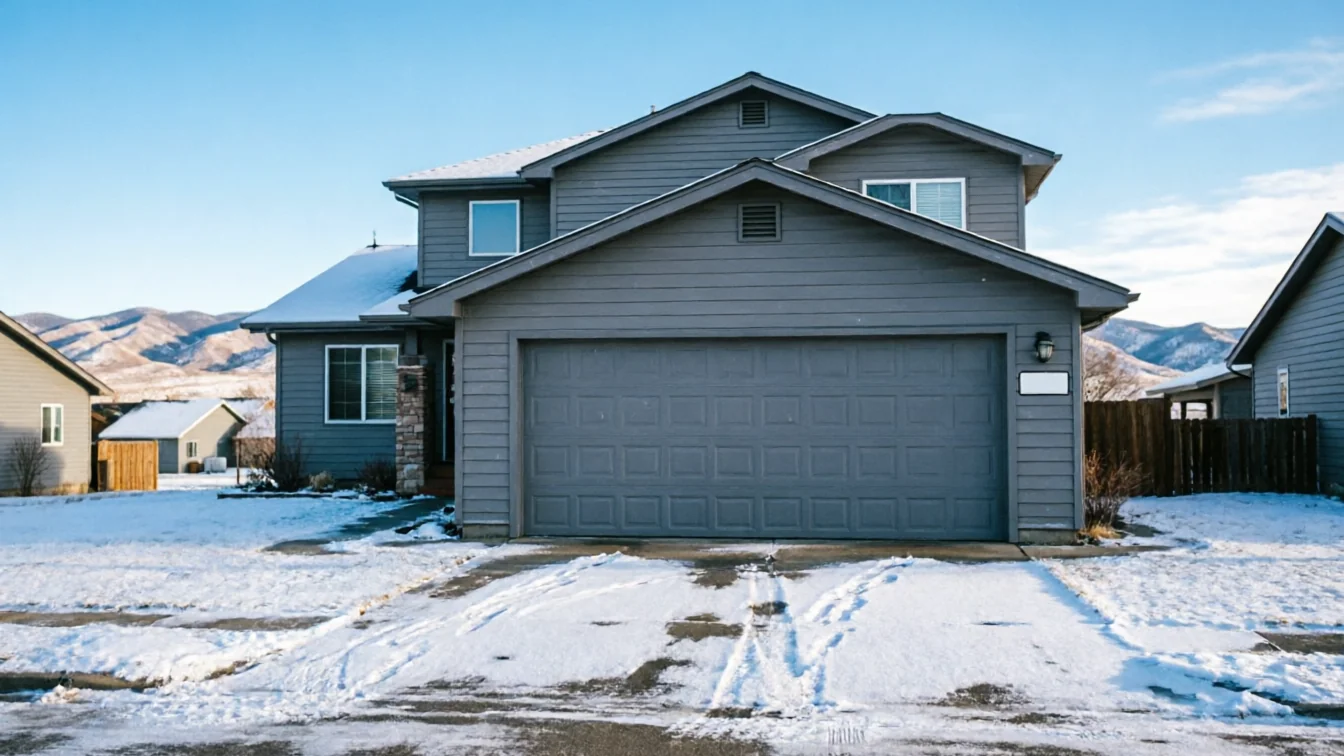
Most of the housing stock around Post Falls went up between 1950 and 2003, with the median build year landing around 1995. That matters more than people think, because a garage door spring is a piece of wound steel with a design life, and a door installed when this town was growing in the 1980s and 90s is now old enough that the wire has been cycling through three decades of winters.
Across the service area there are roughly 11,866 households and about 7,960 owner-occupied houses, and a big share of those sit on torsion hardware that was builder-grade when it went in and has never been touched since. That's not a knock on the builders - it's just what happens when a door gets no attention for 20-plus years in a climate that's hard on metal.
The short version: this isn't a generic "doors wear out" story. It's a specific window of houses, built in a specific stretch of years, now aging into failure at roughly the same time, in a climate that accelerates it. When one spring goes, it's rarely a surprise if you know the build year of the house.
Season by Season
Post Falls sits in a climate band classified as cold-severe, and that shows up in how a garage door behaves month to month, not just on the worst day of the year.
In deep winter, cold steel is less forgiving. A torsion spring that's been fine for years can lose just enough flex overnight that the next cold start is the one that snaps it - this is when a spring goes in cold weather, and it's rarely random; it's wire fatigue meeting a cold morning. Openers struggle too: gear-and-sprocket units bind up when grease thickens, and a door that used to open in three seconds starts taking six.
As it warms, the opposite problem shows up - wood jambs and older tracks that tightened in the cold loosen again, and doors that seemed fine all winter suddenly rattle or walk off-track. That's the freeze-thaw cycle working on fasteners and alignment, not just on springs.
Summer is the forgiving season here - it's when most of the quiet failures from winter finally get noticed and fixed, because nobody's in a hurry when the door's merely loud, not broken. The pattern repeats every year, and houses built in that 1980s-90s stretch are far enough into that cycle that failures cluster.
What Is Going On
Spring steel fatigues with every cycle, and cold makes each cycle harder on the metal. A torsion spring rated for a certain number of cycles doesn't care whether those cycles happened in a mild year or a severe one - but cold reduces the wire's margin, so a spring near the end of its life is far more likely to let go on a cold morning than a warm afternoon.
Houses built in the 1950-2003 window, especially the cluster from the 1980s and 90s, are old enough now that original hardware is reaching or past typical service life. Combine that with a cold-severe climate and you get a predictable pattern: failures bunch up in the coldest stretch of the year, not evenly across twelve months.
Openers follow a similar logic but on a different clock - the motor and gearing don't care about cold the way springs do, but the lubricant does, and an opener struggling against a stiff cold spring will burn itself out faster trying to compensate. That's often why a spring failure and an opener failure show up close together on an older door - one problem creates the next.
Where People Go Wrong
The most common mistake is treating a loud or slow door as a lubrication problem when it's actually a spring near the end of its life. Oil quiets a symptom; it doesn't add cycles back to tired wire.
The second is assuming a door installed in the 1990s still has factory-spec hardware. After two or three decades of a cold-severe winter cycle, most original springs have outlived their rated life even if they haven't broken yet - that's the one you want caught before it fails, not after.
The honest limitation here: we don't replace a spring just because it's old if it's still within a reasonable service window and showing no wear signs. Sometimes the right call is to leave a sound spring alone and revisit it next winter rather than swap parts on a schedule instead of on condition. We also don't stock every opener gear kit on the truck - some parts on older units take a few days to get in, and we'll tell you that up front rather than promise a same-visit fix we can't back up.
The other mistake is waiting until a spring snaps to call. A door that's slow to open, noisy on cold mornings, or visibly sagging on one side is telling you something before it fails completely.
Frequently asked questions
Why do garage door springs break more in winter here?
Spring steel loses some of its flex in the cold, and Post Falls sits in a cold-severe climate band. A spring that's near the end of its life handles a 70-degree afternoon fine but can't take the extra strain of a 10-degree morning, which is why failures cluster in the coldest stretch of the year rather than spreading evenly.
My house was built in the 1990s - is the door original?
A lot of houses in this area were built in that 1980s-90s stretch, and it's common for the original torsion spring and opener to still be in place. After two or three decades of cold-season cycling, that hardware is usually at or past its rated life even if it hasn't failed yet.
Do you service areas outside Post Falls?
We cover the surrounding area, including towns like Rathdrum, Hayden, Dalton Gardens, Spirit Lake, Athol, and Harrison. Distance affects how quickly we can get to a call, so it's worth mentioning your town when you reach out.
Related garage door services in Post Falls
More garage door guides
Book garage door service in Post Falls
Call now or request a quote - tell us what the door is doing and where you are.