Post Falls, ID · Garage Door Service
When an Older Door in Post Falls Is Worth Fixing (and When It Isn't)
Post Falls homes mostly date 1950-2003 with a 1995 median build year. Here's how that housing stock and our cold winters decide if a door repair or replacement makes sense.
- Repairs & new doors
- Springs & openers
- Serving 5 nearby communities
What Local Conditions Do
Most houses in this part of town went up between 1950 and 2003, with the median landing around 1995. That matters more than people think. A door built in the 80s or 90s is usually steel, usually on a torsion spring, and usually still running on the original opener if nobody's touched it. Thirty-odd years of that combination means the hardware is at the end of its rated cycle count even if the door looks fine from the driveway.
We're in a cold-severe climate band here, which is a different stress than wind or hail. Cold tightens steel, stiffens grease, and shrinks weatherstripping until it stops sealing. A spring that's been cycling for twenty winters in that kind of cold loses tension faster than the same spring would somewhere mild. So when we look at a door, we're not just asking how old it is - we're asking how many cold winters it's actually worked through.
With close to 8,000 owner-occupied houses in a service area of just under 12,000 households, a lot of these doors are the same age, the same style, and hitting the same wear points at close to the same time. That's useful - it means we see the failure pattern before it happens to your door, not after.
Season by Season
Winter is where the cold-severe part of our climate actually shows up in a garage. Cold-stiffened lubricant on rollers and hinges makes an opener strain harder than it should, and a spring that's borderline will usually let go in a cold month, not a warm one - the metal is less forgiving when it's contracted. If your door's been getting slower or louder as the temperature drops, that's not your imagination.
Spring and fall are swing seasons, mechanically. Temperature cycling between freezing nights and warmer days works fasteners loose and flexes weatherstripping that's already brittle from winter. This is when a track that was slightly out of alignment finally lets a roller jump.
Summer is the easy season on the hardware, but it's when most owners notice their door the least - which is exactly why a door that's quietly been losing spring tension all winter can seem to fail out of nowhere in July. The failure was building the whole time; summer is just when nobody was paying attention.
What Is Going On
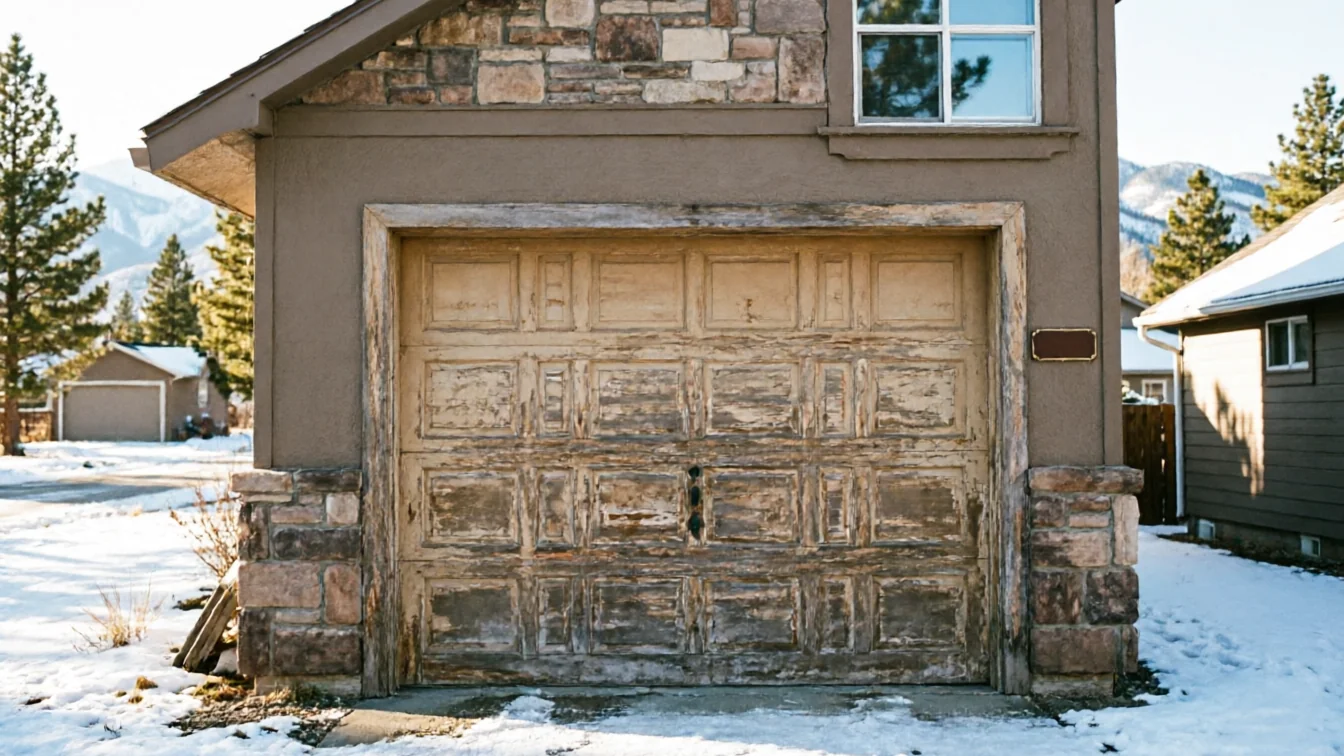
A door built when the median house here went up - call it the 1980s through 1995 - was built to a different spec than what's sold today. Panel gauges were often thinner, insulation (if there's any at all) is minimal, and the original torsion spring was sized for the original door weight, not for whatever's been added since. None of that is a defect. It's just a different door for a different era, in a town where a large share of the housing matches that description.
The cold-severe rating isn't abstract either. It's the reason steel springs lose coil tension faster here than they would in a milder climate, and the reason nylon rollers crack instead of just wearing down. A repair on a door like this often means replacing more than the single broken part, because everything around it has been aging at the same rate under the same conditions.
That's the honest tradeoff: an older door can almost always be repaired once. Whether it should be is a separate question, and it depends on how many of its other original parts are already close behind the one that just failed.
Where People Go Wrong
The most common mistake is replacing just the part that broke - usually a spring or a cable - on a door that's otherwise original from the 1980s or 90s, and then being back out again within a year or two for the next original part. If the spring just went, the rollers, cables, and hinges are the same age and the same cold-cycled metal. Fixing one without looking at the rest just moves the next failure down the calendar.
The other mistake is the reverse: replacing a whole door and opener because one spring broke, when the rest of the hardware has plenty of life left. A broken spring on an otherwise sound door, with a frame and track that are still square, is usually a straightforward repair, not a reason to start over.
We won't pretend every older door is worth saving - some aren't, and we'll tell you that on the spot rather than sell you a repair that's just delaying the real job. But we also won't talk you into a full replacement because the one part in front of us happened to be the loud one. We work Post Falls and the surrounding area out to places like Rathdrum, Hayden, and Dalton Gardens, and we see this same housing stock and the same winters on all of it.
Frequently asked questions
How do I know if my garage door is original to the house?
If the house dates to the 1980s or 90s, which covers a large share of homes here, and nobody has a receipt for a door replacement, it's probably original. Look for a single steel torsion spring, a lack of foam insulation on the panel backside, and an opener that predates rolling-code remotes. Any of those point to original equipment.
Is it worth fixing a 30-year-old spring instead of replacing the door?
Usually, yes, if the track is straight and the panels aren't dented or rusted through. A spring replacement on an otherwise sound older door is a contained repair. It stops being worth it once you're also looking at a bent frame, rotted jamb, or an opener that's failing alongside the spring.
Why do springs seem to fail more in winter here?
Cold contracts and stiffens steel, which changes how a torsion spring holds its wind. A spring that's been losing tension gradually for years is more likely to finally let go on a cold morning than a warm afternoon, because the metal has less give left in the cold.
Do you work outside Post Falls?
Yes. We cover the surrounding area including Rathdrum, Hayden, Dalton Gardens, Spirit Lake, Athol, and Harrison, in addition to Post Falls itself.
Related garage door services in Post Falls
More garage door guides
Book garage door service in Post Falls
Call now or request a quote - tell us what the door is doing and where you are.